Control and Metering Bulk Bag Fillers Save $700K

Posted by Don Mackrill on Fri, Dec, 02, 2011 @ 10:12 AM

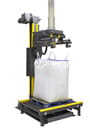
A manufacturer of bulk ingredients that enjoys robust export sales were satisfied with their Control and Metering CTE cone table bulk bag fillerbulk bagging operation.  Based on the bulk density of the product and their bulk bag filling equipment - 6 bulk bagging lines in 2 plants - they were able to achieve payload weights of 1,900 lb per big bag.
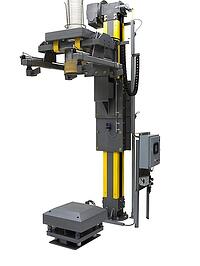
However, bulk bag stability was sometimes an issue and customer complaints regarding safety and efficient bulk bag handling were increasing.

Control and Metering suggested an Optimization Analysis that would investigate every aspect of the manufacturer's bulk bagging operations including upstream product distribution to the bagging lines, the filling equipment and processes, handling, storage and shipping.

The Optimization Analysis was comprised of three steps;

  1. Preliminary Analysis.  Conducted over the phone, a one hour session with the manufacturer's production and logistics teams delved into every nook and cranny of their bulk bag operation and provided a wealth of data.  Careful analysis revealed that the application of Control and Metering's cone table densification technology could likely solve the instability problem and potentially increase bulk bag payload weight thereby reducing packaging and shipping costs.
  2. Detailed Analysis.  A site visit was arranged to verify the preliminary data and assess the feasibility of making changes to the packaging lines.  During this visit the scope of a potential project to improve bulk bagging began to take shape.
  3. ROI Analysis.  Refinement of the preliminary analysis based on the information gathered during the site visit supported the initial indications that the instability problem could be solved and operating costs reduced.  An economic analysis revealed that, based on the manufacturer's annual bulk bag shipments of approximately 160 million lb, increasing the bag payload weight between 10% and 15% could save over $525k in shipping costs (based on a conservative cost per shipping container of $1,000).  Since increasing the payload per bag means that fewer bulk bags are required, a further annual saving of $175K could be realized simply because they could buy fewer big bags.

Clearly, the potential annual operating cost savings were significant.  This quickly led to testing at Control and Metering that confirmed both the elimination of the instability problem and that the increased payload weight per bag could be achieved.

When compared against the total cost of the project required to convert their existing bulk bagging lines to cone table technology, the simple payback of the project was less than 12 months!

The above story is a real life example of an Optimization Analysis can reveal significant financial and operational improvements even with a bulk bagging operation where the status quo is perceived as being just fine or almost perfect.

Note that the Optimization Analysis phase including the site visit and testing were provided without cost to the manufacturer - this is a standard feature of Control and Metering's Optimization offering.

Finally, the manufacturer in this case ships a LOT of product in bulk bags.  If your company or facility ships significantly less product than 160 million lb/year there can still easily be a very attractive profit improvement opportunity lying dormant in your plant.

Annual shipping totals of even as low as 10,000 bags can still generate financially attractive opportunities with simple paybacks less than 24 months.  A preliminary analysis session over the phone will reveal whether your plant can improve its profit while potentially solving nagging operational problems!

Answer 8 simple, bulk bag operation questions to see if your plant can benefit from a Control and Metering Optimization Analysis!

For more information contact Joe Natale at joe@ControlandMetering.com or 416-473-1500.
Topics: big bag, bulk bag cost savings, bulk bag optimization, bulk bagging

Sugar in Big Bags Not Small Bags: Excellent ROI

Posted by Don Mackrill on Fri, Nov, 04, 2011 @ 10:11 AM

A major Caribbean beverage producer - juices, soft drinks, etc. - wanted to improve productivity related to sugar handling.

Their current process involved manually breaking 50 Kg bags at multiple locations. Not only was this labor intensive, but it was soon to be a bottleneck that would impede planned increases in production output.

Working with their primary sugar supplier, one of the largest sugar brokers in the region, and Control and Metering, the beverage company created a plan to achieve their productivity goals and increase the scale of their sugar handling to meet higher production rates by changing incoming sugar packaging to big bags and designing a new sugar batching system.

Big Bags versus Small Bags

Handling sugar required six operators continuously breaking and dumping 50 Kg bags at three locations.

Plus, the 50 Kg bags had to be unloaded from shipping containers one bag at a time and placed in storage manually. This also required multiple operators.

Converting to big bags would allow container unloading to be performed by one operator with a forklift.

Instead of six operators breaking bags at three locations, current production and planned growth for the next two years could be managed by one operator and two automated big bag batching stations.

Batching Sugar from Big Bags

The big bag sugar batching systems were designed to precisely convey sugar to syrup mixing tanks to produce standard brix syrup that would be pumped to all of the beverage production lines in the plant.

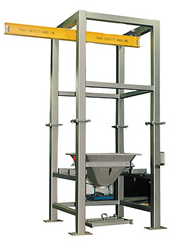
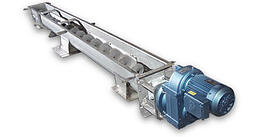
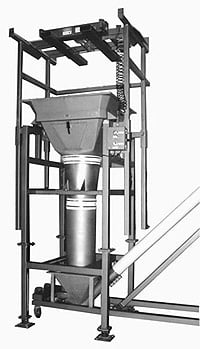
Each big bag batching system included a Control and Metering F60 monorail big bagControl and Metering Flo 60 bulk bag discharger discharger, an incline screw conveyor and an automated batch weighing control system.
Big bags would be moved to the production area and the single sugar batching operator would move individual big bags to each of the two big bag batching stations using a pallet truck. The big bag would then we rigged to a lifting frame and placed into the F60 big bag discharger using an integral hoist and trolley.

Screw conveyorThe operator would then safely open the big bag outlet spout within the F60 hopper to initiate sugar flow and, by pressing a single button on the control panel, start the batch.
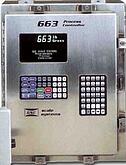
The automated batch weighing system would thenControl panel control the conveying of sugar from the big bag to the syrup mixing tank according to the syrup recipe.
Economic Benefit of Converting from Small Bags to Big Bags

The fully benefited labor rate at this location is $2.72 USD per hour. Even at this relatively low rate (compared to North America and elsewhere), first year labor savings were calculated to be $152,000 USD with second year savings of $196,000 USD based on increased production.

This resulted in a simple payback for the project of only 21 months. Clearly, the ROI on this project was very attractive!


For more information contact Don@ControlandMetering.com.

Topics: big bags, bulk bags, bulk bag unloading, bulk bag batching system, sugar, 50 Kg bags

Bulk Bag Conditioning

Posted by Don Mackrill on Tue, Jul, 05, 2011 @ 13:07 PM

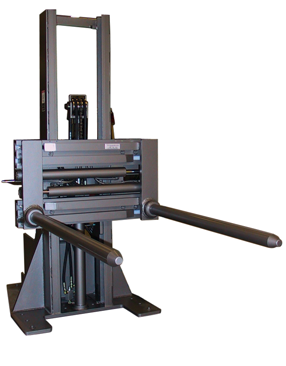
Bulk bag conditionerBulk bag conditioners have become increasingly popular over the past few years.  However, there is still much confusion on the part of bulk bag users regarding what conditioners do and when they should be used.
Bulk Bag Conditioners - How They Work

There are many specific designs on the market, but they all perform the same function: breaking up solidified ingredient in bulk bags.

Some designs use multiple squeezing attachments on 2 or more sides.  Others (like the Control and Metering Bag Squeezer) use only two squeezing poles.  Most are hydraulically driven, but there are a few that rely on air pressure to provide the squeezing force.

Bulk Bag Conditioning Automation

Most bulk bag conditioners are specifically designed to have one bulk bag placed manually in the conditioner and then manually removed.  However, some designs (at least one!) can be configured in an automated system that allows bulk bags to be staged and fed into and removed from the squeezer automatically.  This can dramatically reduce the amount of time required to squeezer bulk bags and significantly increase productivity.

Bulk Bag Conditioners - When To Use Them

Bulk bag conditioners are designed to break up ingredient that has 'set' in a bulk bag.  This situation results in what is essentially a solid block of ingredient that must be broken up for it to flow through the bulk bag's outlet spout.  There are some situations where the ingredient has not set into one block, but instead has several very large pieces that have solidified.

Bulk bag conditioners are NOT designed to break up softball or football or basketball sized chunks of ingredient.  In that case, a lump breaker is required to break up the lumps.

Topics: bulk bag conditioner, bulk bag conditioning, bulk bag squeezer

Bulk Bag Batching: Improve Weighing Accuracy

Posted by Don Mackrill on Tue, Jun, 21, 2011 @ 10:06 AM

Bulk bag batchingRecently, we engaged with a customer that a few years ago had spent over $2 million with another vendor on an 18 station, automated bulk bag batching system.  Depending on the recipe some or all of the 18 different ingredients are simultaneously metered onto a common belt conveyor for transfer to one of two mixers.  Each station dispenses its ingredient in specific batch weights according to the recipe.
Unfortunately, the system doesn't work.

Individual ingredient batch weights are inaccurate and vary both above and below the weight setpoint and the variations are random.  Therefore, the total recipe weights are inconsistent and are randomly under or over weight.

As a result, they have had to go back to adding most of the ingrdients by hand and use the automated system for only four or five ingredients.

The customer asked Control and Metering if we had any ideas that might help them.  Based on a very brief overview of the system and how it operates we identified two key factors that we believe may be root causes of the weighing problem.  These factors are critical to achieving success with any batching system.

  1. Dry bulk solid metering device selection.  The 18 ingredients vary dramatically in their bulk density, particle size distribution and flow characteristics.  Each station must be optimized for its ingredient so that the bulk bag discharger maintains a steady flood feed condition to the metering device and so that the metering device is properly selected to maintain a constant - and therefore accurate - feed rate when it is dispensing its batch.  In this case, vibratory feeders were supplied at every station, which appear to be inneffective with many of the ingredients.
  2. Batch weighing structure integrity.  Each of the 18 bulk bag batching stations are constructed of 3" steel tubing and the metering devices - vibratory feeders - are suspended below each frame on chains.  Load cells are located under each of the bulk bag discharger legs.  We suspect that the overal structure lacks integrity and may well exhibit hysteresis - the frame subtly shifts each batch run or series of batch runs and the weighing system physically alters its orientation - perhaps by only millimeters - between batches.  Further, it may be that frame flexing occurs during batch operation.  Both of these phenomenon, if they are occuring, would lead to random batch inaccuracies.  The weigh frame or weighed structure must be designed to avoid frame flexing and deformation so that the weighing system remains structurally rigid from batch to batch.
As can be seen, a properly designed bulk bag batching system must be designed specifically for each ingredient.  Unless multiple ingredients are similar in bulk density and flow characteristics, it is highly likely that each station will have its own optimum design solution.

Learn more about bulk bag batching systems.


Topics: bulk bag, vibratory feeder, bulk bag batching, batching system, bulk bag batching system

Sizing Bulk Bags: Filling Technology Can Save Money

Posted by Don Mackrill on Wed, Jun, 15, 2011 @ 15:06 PM

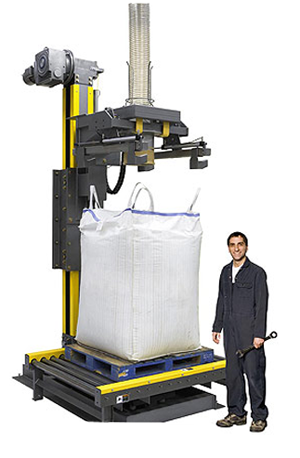
CTE bulk bag fillerAs was pointed out in an earlier blog post "How Big is A Bulk Bag", there is no such thing as a 'standard' sized bulk bag.  The base or bottom seam dimensions are generally sized to fit within the mode of shipping to be used (shipping container, truck trailer, etc.) and/or to fit properly on the selected pallet.
Depending on the bulk density of the product and its characteristics, the bulk bag's height can be significantly affected by the bulk bag filling technology employed.  And, this can be a source of lucrative operating cost savings!

If your product's packed bulk density is around 35 lb/cu ft or less and its loose bulk density is more than 10-15% less than that, chances are reasonable that you are not able to achieve bulk bag weights of 2,000 to 2,205 lb using bulk bags sized to fit within a shipping container or a truck trailer.

If that's the case, maximum densification during filling can in most cases put more weight into the same sized bulk bag.

When that happens operating cost savings pile up quickly:

  • Since you can put more weight in each bag, you can buy fewer bags.  A 10% increase in payload weight equals a 10% reduction in the number of bags you have to buy!
  • Since you can put more weight in a container or trailer there are fewer shipments that must be made and each shipment carries more weight per container.  Once again, a 10% increase in payload weight reduces the number of containers thereby reducing shipping costs.  This can be a HUGE cost savings!

So, if you are unable to currently achieve one ton/tonne payload weights in your bulk bags investigate using bulk bag filling technology that will mazimize densification.  You may be able to put tens and even hundreds of thousands of dollars onto your plant's profit line by increasing the payload weight of your current sized bulk bags !

Learn about Control and Metering's cone table bulk bag filling technology that provides maximum densification.

Topics: bulk bag filler, bulk bag dimensions, bulk bag, bulk bag size, bulk bag filling

Loose Bulk Bag Liners and Dry Bulk Ingredient Flow Problems

Posted by Don Mackrill on Mon, Jun, 06, 2011 @ 08:06 AM

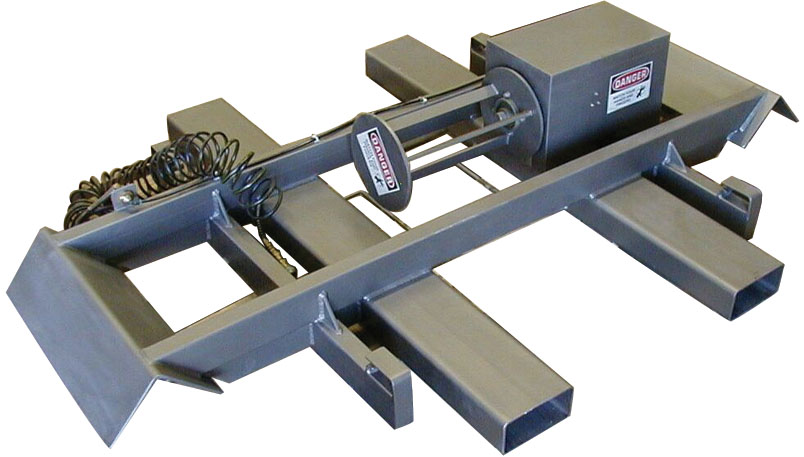
Control and Metering bulk bag liner tensionerDo you receive ingredient in bulk bags with loose liners?  Do you have problems getting the ingredient to flow from the bulk bag?  Here's some tips on how to overcome bulk bag discharging flow problems.
Focus on how the bags are filled.  

Flow problems often are the result of the bulk bag liner not being inflated prior to filling.  If this crucial step is not taken, the liner can fold over itself in the bottom of the bag.  If that happens and a ton of ingredient is filled into the bag on top of the folds, flow problems are sure to occur.

The only way to prevent this is to properly inflate the liner just prior to filling so that it takes the shape of the bulk bag without folding over on itself.  Talk to your supplier or, if you fill bulk bags for in-house or intra-company use, take a close look at your bulk bag filling equipment and standard operating procedures.

Optmize liner handling during discharge.  

Liner tensioners are devices that wind up loose liners during discharge to prevent them from 'growing' too far out of the bottom of the bulk bag and becoming entangled in downstream equipment.  They also improve product flow and ensure that all of the ingredient is discharged from the liner thereby providing 100% yield.

Using one of a number of different styles of liner tensioner can prevent flow problems from bulk bags with loose liners.

  • Hold in place.  The simplest type of liner tensioner simply holds the liner in place to prevent it from completely exiting the bottom of the bag during discharge.  Make sure that there is sufficient space between the bottom of the bag and the downstream equipment so that when the liner grows out of the bag during dicsharger it doesn't become entangled in downstream equipment.  Also note that this style tensioner does not pull up on the liner and therefore does not do an effective job of ensuring complete discharge.
  • Partial wind up.  A pneumatically actuated tensioner winds up a predetermined amount of the liner during discharge - say 24" - 36".  This reduces or eliminates liner growth out of the bag bottom and ensures complete discharge.
  • Complete wind up (see photo above).  If you use a discharger that clamps the liner outlet you must use a tensioner that continuously winds the liner.  Otherwise, the liner will gather at the clamp and almost always prohibit ingredient flow.  This type of discharger and tensioner are typically used when dust containment is critical.

Topics: bulk bag, bulk bag discharging, loose bulk bag liners, bulk bag discharger, bulk bag liners

Key to Bulk Bag Stacking: A Flat Top!

Posted by Don Mackrill on Thu, May, 26, 2011 @ 09:05 AM

There are a number of factors involved in successfully stacking bulk bags.  The one most overlooked is that your filled bulk bags must have a flat top!

Most dry bulk solids have an angle of repose.  If you pored a handfull of your product on a flat surface it would form a peak.  The angle of the peak with the horizontal varies depending on the properties of the product.

When product is poured into a bulk bag it forms a peak just the same as the example above.  However, if you plan to stack bulk bags it is critical that your bulk bag filling equipment densifies the product enough to produce a flat top.

A filled bulk bag with a flat top provides a stable platform on which to stack.  Without it, the odds of a leaning or falling stack are greatly increased.

If you are stacking bulk bags or plan to, safety is the first priority.  Make certain that your bulk bag filling equipment can produce a flat topped bag before you do anything else!

See how Control and Metering's cone table densifiction technology produces flat topped bulk bags!

Topics: bulk bag filler, bulk bag densification, bulk bag, cone table, bulk bag filling

Bulk Bag Baffles: What Are They and When To Use Them

Posted by Don Mackrill on Thu, May, 19, 2011 @ 14:05 PM

Baffle bulk bagBaffles are pieces of plastic fabric that are sewn vertically across each of the four corners of a bulk bag.  The fabric pieces have holes in them so that product can flow 'through' them and fill the corners of the bag.

You can see the vertical seams of the baffles in the photo at the left.

There are two reasons to use baffles:

  1. Bulk Bag Stability.  If you suffer from unstable bulk bags, baffles can improve their stability and safety.
  2. Bulk Bag Shape.  Baffles counteract the natural tendency of a bulk bag to 'round out' - a filled bulk bag will be almost circular in horizontal cross section at a point midway up its height. Sometimes this can cause problems when trying to maximize the load in a truck trailer or a shipping container.  Baffled bags are virtually square in cross section when they are filled.

Baffles are costly.  They can add as much $5 - $6 dollars per bag.  Therefore, their use should be carefully evaluated.

If you are considering baffles to improve bulk bag stability, compare the life cycle cost of using baffles at $5 per bag vs. the one time capital cost of filling equipment that can densify your product properly and produce a safe package with baffles.

Depending on how many bulk bags you fill per year, it doesn't take long for a properly designed bulk bag filler to pay for itself vs. having to spend $5 per bulk bag for the life of the production line.  

Topics: bulk bag filler, bulk bag, bulk bag filling, bulk bag baffles

Bulk Bag Filler Packages Fertilizer in Wastewater Treatment Facilities

Posted by Carolynn Sarver on Sat, Jan, 15, 2011 @ 17:01 PM

Topics: bulk bag filler, bulk bag fillers, bulk bag handling equipment, bulk bagging equipment, super sack loading equipment, bulk bag filling equipment, super sack loader

Bulk Bag Sifting - Dust Emissions From Bulk Bags

Posted by Don Mackrill on Fri, Sep, 17, 2010 @ 11:09 AM

We got a call from a customer the other day who asked us to evaluate a chronic dusting problem that occurs when they fill bulk bags with their fine powder product.  Turned out that it was more a much more complex situation than it sounded like on the phone!

A site visit revealed the problems symptoms.  As soon as a bag started to fill dust begins to escape along the seams at the top of the bag where the top panel is sewn onto the sides of the bulk bag.  The product was 'sifting' through the top panel seams.

This being a very fine powder, the sifting caused a significant cleanliness issue.  However, the customer finally decided to tackle this long standing issue because of the problem's potential impact on the health of operators and it's impact on profitability - product falling on the floor was not being paid for by customers!

A quick review of the situation revealed several potential root causes of the problem:

  • Faulty bag inflation.  The customer inflates every bag prior to filling.  Initial observation indicated that once product began to flow into the bag, it appeared that the bulk bag remained 'taut'.  Was the inflation system continuing to force air into the bag during filling?  If so, the excessive positive air pressure in the bag that would result from the inflation system continuing to run during filling could easily overcome any treatment of the top panel seams designed to prevent sifting.
  • Inadequate dust extraction.  As a bulk bag is filled the air in the bag is displaced by the product flowing into the bag.  A means of removing this displaced air must be provided or excessive positive air pressure in the bag may occur during filling.  Per the above, this could lead to sifting through the bulk bag's sewn seams.
  • Poor bulk bag construction.  In a situation where inflation and dust collection systems are operating properly, the cause of the sifting may be that the bulk bag is constructed with ineffective seam treatments that are designed to prevent sifting.

In this case the customer was interested in acquiring an 'area' type dust collection system to extract the product from around the top of the bulk bag.  In other words, they were looking at dealing with the symptom of the problem and not its root cause.

The solution they were contemplating is, in my experience, almost always ineffective.  Trying to blanket a relatively large area with a negative pressure source in hopes of vacuuming all of the fugitive dust particles either requires an enormous amount of air flow or simply does a poor job.  Further, any hope of reintroducing the collected product particles back into the packaging system so that it is not wasted is crushed because of the potential for sucking up contaminants along with the dust.

So, the proper process to deal with a situation like this is to carefully troubleshoot the system to determine the root cause.

Topics: bulk bag filler, dust collection, dust extraction. bulk bag, bulk bag filling